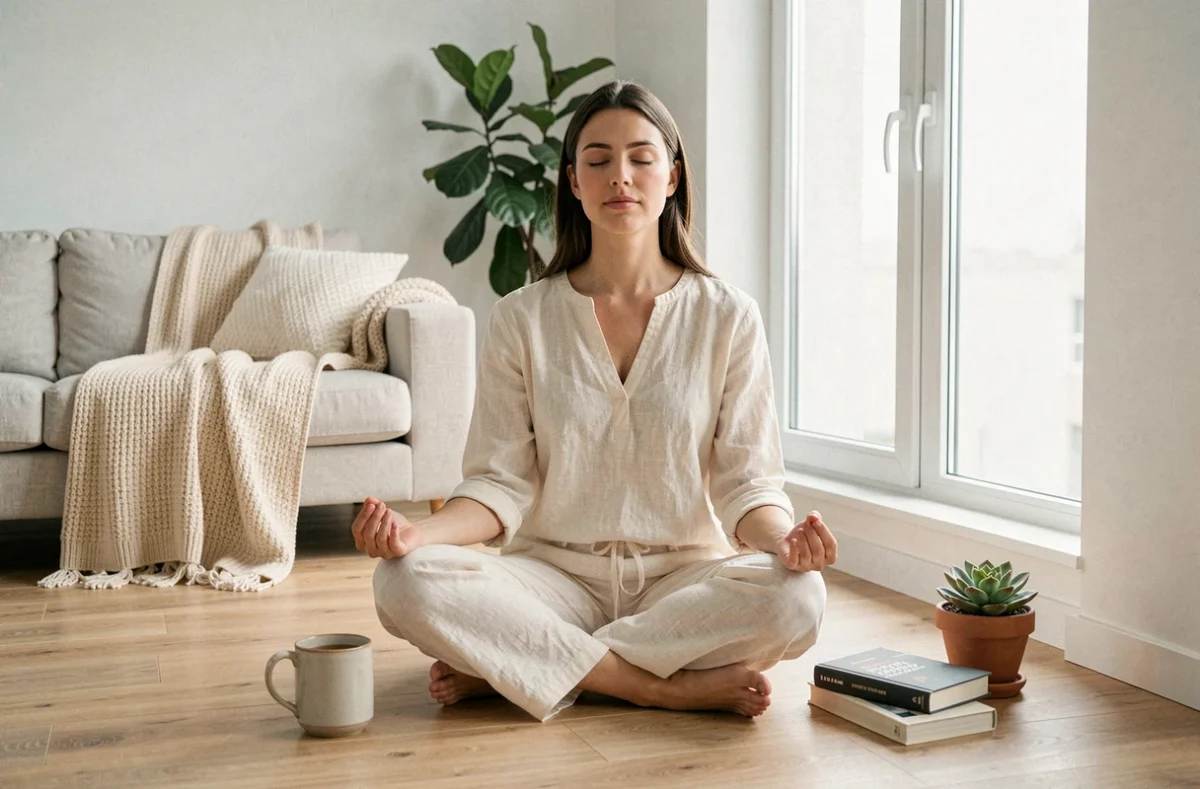
Improving daily well-being does not rely on a radical upheaval of habits. Recent public health data shows that targeted, regular, and modest adjustments produce measurable effects on stress, sleep, and energy. This article isolates ten concrete practices, each supported by a specific mechanism, to help identify those that correspond to your situation, capabilities, and schedule.
1. Break up sitting time with micro-movements
Recent health recommendations clearly distinguish scheduled physical activity from prolonged sitting time. Getting up and walking for a few minutes at regular intervals is a specific measure, even for those who already engage in sports.
Specifically, interrupting each hour of sedentary behavior with two to three minutes of walking is enough to boost blood circulation and reduce cognitive fatigue. This habit easily integrates into a workday in front of a screen, requiring no equipment or dedicated time slot.
Resources addressing well-being on Soins, Beauté & Sante remind us that this fragmented approach produces distinct benefits from those of a traditional workout session, acting on posture and alertness throughout the day.
2. Keep a short writing journal in the evening
Free writing, even limited to a few lines, frees up mental space. Writing down thoughts, priorities, or simply what marked the day helps to reduce accumulated mental load and gain perspective before sleep.
This journal does not need to be structured. Three sentences are sufficient. The goal is to put on paper what clutters the mind, to avoid nighttime rumination that degrades sleep quality.
A point of caution is necessary for those using a digital mental health tracking app: these tools handle sensitive health data. Informed consent and compliance with health data regulations should be verified before regular use.
3. Prioritize regularity over intensity in physical activity
A daily walk of twenty minutes produces more lasting effects than an occasional intense session. Mental health recommendations link regular, even moderate, physical activity to better management of anxiety and stress symptoms.
A short walk is a realistic first step, adaptable to all physical capabilities. It requires no registration, no equipment, and no exceptional motivation. Consistency is more important than performance.

4. Structure a sleep routine with fixed hours
Sleep is the physiological foundation of well-being. Maintaining stable bedtimes and wake-up times, including on weekends, regulates the circadian rhythm and improves perceived rest quality.
Two concrete levers help reinforce this regularity: turning off screens at least thirty minutes before bedtime and lowering the room temperature. These two adjustments directly affect melatonin production.
The quality of sleep conditions energy, concentration, and stress resistance for the following day. Improving this single parameter has cascading effects on other dimensions of well-being.
5. Practice abdominal breathing in stressful situations
Slow abdominal breathing activates the parasympathetic nervous system, which decreases heart rate and muscle tension in just a few minutes. This physiological mechanism can be used anywhere, with no preparation.
A simple technique: inhale through the nose for four seconds while expanding the belly, then exhale through the mouth for six seconds. Repeating this cycle five to six times is enough to produce a measurable effect on perceived stress levels.
6. Adapt advice to your actual capabilities
French prevention is evolving towards adapted physical activity pathways, taking into account age, capabilities, schedule, and environment. Applying a uniform list of habits without considering one’s own constraints often leads to frustration rather than well-being.
For someone suffering from a chronic illness or having physical limitations, the challenge is to identify adjustments compatible with their daily life. A gentle exercise practiced regularly is worth more than an ambitious program abandoned after two weeks.
7. Limit sources of anxiety-inducing information
Continuous consumption of news, particularly through smartphone notifications, maintains a state of constant vigilance that depletes cognitive resources. Setting specific times to inform oneself, rather than enduring a continuous flow, significantly reduces perceived stress.
Disabling non-priority notifications and limiting social media consultation to chosen moments are two concrete actions. Choosing your information slots protects the quality of the day without cutting off connection to current events.
8. Integrate screen-free breaks into the workday
Micro-breaks without visual stimulation allow the brain to switch to diffuse mode, fostering creativity and problem-solving. Five minutes with eyes closed or looking out the window is sufficient.
This type of break is distinct from merely switching applications. Scrolling through social media during a break does not produce the same recovery effect as a moment of total disconnection.
9. Recognize signals that justify professional support
Self-help advice does not cover all situations. According to the synthesis of WHO mhGAP recommendations on anxiety, persistent anxiety that disrupts sleep, work, or relationships requires referral to a mental health professional.
Identifying this threshold avoids two pitfalls: minimizing a suffering that sets in, or overloading oneself with stress management techniques when the situation warrants therapeutic support. Signs to watch for include:
- Anxiety lasting several weeks without improvement despite daily adjustments
- Recurring physical symptoms (persistent sleep disturbances, chronic muscle tension, unexplained fatigue)
- A marked impact on professional activities or personal relationships
10. Build an end-of-day ritual to mark the transition
Clearly separating work time from personal time helps the body and mind switch to recovery mode. This ritual can be minimalist: tidying up the desk, preparing herbal tea, walking for ten minutes.
The effectiveness lies in repetition, not sophistication. An identical gesture each evening creates a signal that the brain learns to associate with relaxation. This conditioning mechanism gradually reduces the time needed to detach from work concerns.
| Tip | Time Required | Main Effect |
|---|---|---|
| Micro-movements | 2-3 min/hour | Reduction of sedentariness |
| Writing journal | 5 min/evening | Mental load |
| Regular walking | 20 min/day | Stress management |
| Fixed sleep hours | 0 min (habit) | Sleep quality |
| Abdominal breathing | 2-3 min as needed | Acute stress |
| Adaptation to capabilities | Variable | Sustainable adherence |
| Information slots | 0 min (restriction) | Screen-related anxiety |
| Screen-free breaks | 5 min/break | Cognitive recovery |
| Professional threshold | As needed | Appropriate referral |
| End-of-day ritual | 10 min/evening | Work-rest transition |
Each of these practices acts on a distinct lever: sleep, stress, sedentariness, mental load. Adopting them all simultaneously would be counterproductive. Starting with the one that addresses the most pressing need, maintaining it for a few weeks, and then adding a second remains the most reliable method for ensuring these adjustments are lasting.