Traveling around the globe allows you to discover a rich cultural diversity, and one of the most beautiful ways to appreciate this diversity is to learn how to say ‘thank you’ in different languages. Whether it’s a simple ‘thank you’ in English, a warm ‘gracias’ in Spanish, or a respectful ‘arigatou’ in Japanese, each expression of gratitude carries a part of the local culture.
Expressing gratitude in the native language of your interlocutors creates stronger bonds and shows deep respect for their culture. In addition to enriching your language skills, it opens doors and hearts wherever you go.
Expressing gratitude in the most spoken languages
Traveling around the world and communicating with its inhabitants requires mastering a few basic expressions, particularly those that allow you to show your appreciation. Learning to express gratitude in different languages is an act of respect and courtesy.
- English: ‘Thank you’ remains the classic and universal phrase. For more formal contexts, use ‘Thank you for your prompt response’ or ‘I am grateful for your assistance.’
- Spanish: ‘Gracias’ is the magic word. To reinforce your expression of gratitude, you can say ‘Muchas gracias’ or ‘Te lo agradezco.’
- Mandarin: ‘Xièxiè’ (谢谢) is the basic expression. For more formal situations, use ‘Xièxiè nǐ de bāngzhù’ (谢谢你的帮助) which means ‘Thank you for your help.’
- Hindi: ‘Dhanyavaad’ (धन्यवाद) is appropriate to show your gratitude. Another common expression is ‘Bahut dhanyavaad’ (बहुत धन्यवाद) which means ‘Thank you very much.’
- Arabic: ‘Shukran’ (شكراً) is the standard expression. For a more emphatic thank you, you can say ‘Shukran jazeelan’ (شكراً جزيلاً).
- French: ‘Merci’ is the most common expression. You can also say ‘Je vous remercie’ for more formal situations.
- Greek: ‘Efcharistó’ (ευχαριστώ) is the basic expression. To show greater respect, say ‘Efcharistó polý’ (ευχαριστώ πολύ), which translates to ‘thank you in Greek’.
Expressing gratitude authentically and appropriately varies according to cultures and languages. Formal expressions such as ‘Thank you for your hard work and dedication’ in English or ‘Merci pour votre travail acharné et votre dévouement’ in French show a higher level of recognition and are essential in professional settings. In contrast, informal expressions like ‘Thanks a ton!’ or ‘You rock!’ in English can be used in more relaxed and friendly contexts.
Learning expressions of gratitude in different languages will not only strengthen your relationships but also show your respect for local cultures.
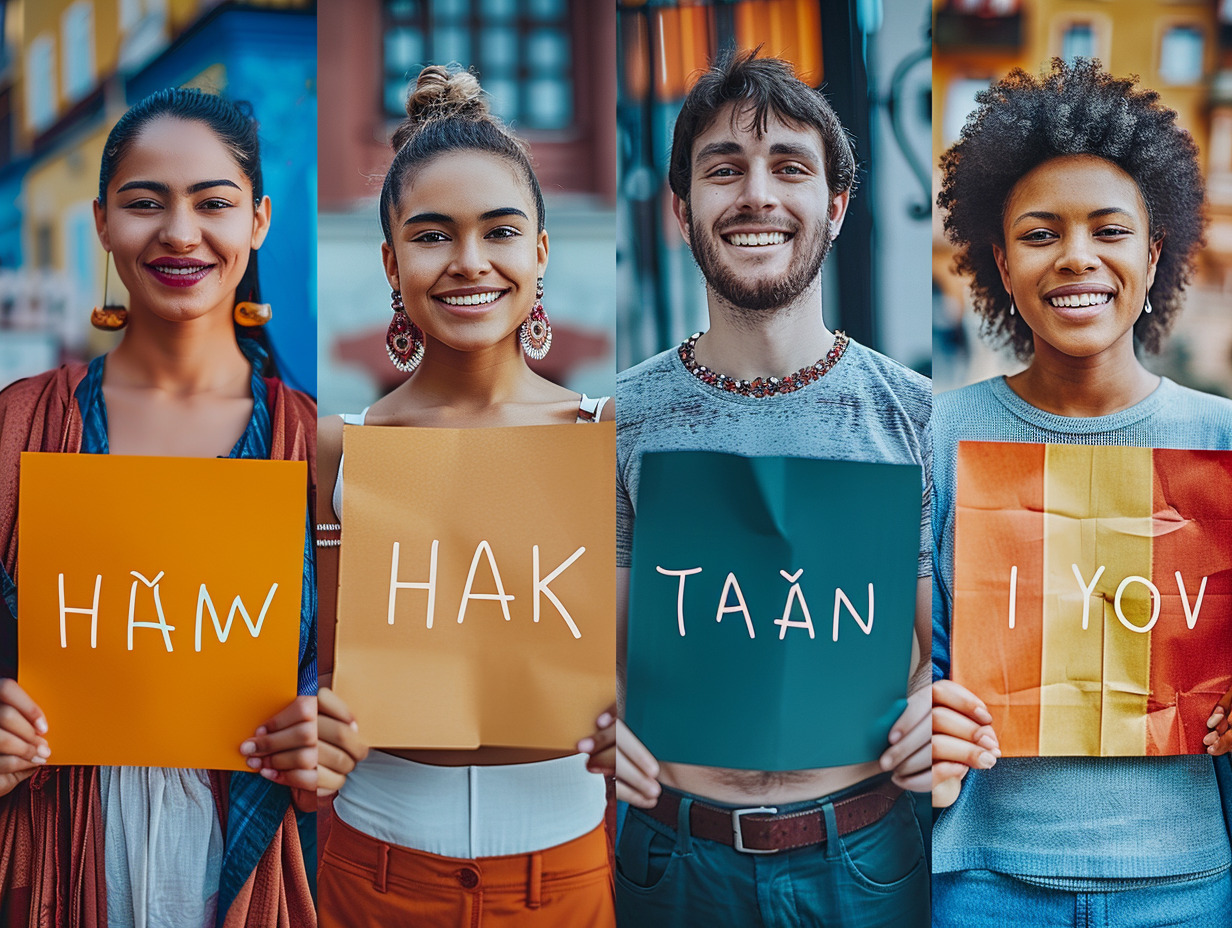
The cultural nuances of gratitude around the world
Traveling and interacting with diverse cultures teaches us that gratitude is not a universal concept, but varies according to traditions and social contexts.
In France, recognition is often expressed with a simple ‘merci’, but the French may add a hand gesture or a hug to reinforce their sincerity. In contrast, in Canada, the expression of gratitude is more expansive. ‘Thank you’ is often accompanied by a smile and, sometimes, a compliment to emphasize appreciation.
Take Portugal, for example. There, saying ‘Obrigado’ or ‘Obrigada’ depending on gender is commonly followed by a slight nod of the head, demonstrating deep respect. In Syria, gratitude takes on a more ceremonial dimension. Saying ‘Shukran’ may be followed by a series of compliments and blessings, accentuating the solemnity of the thank you.
The role of gestures and context
Farsi culture, in Iran, also highlights the importance of gestures. Saying ‘Mamnoon’ (ممنون) is often accompanied by a hand on the heart, signifying that the gratitude comes from deep within.
In Europe, linguistic and cultural diversity leads to subtle but significant variations. In Germany, for example, a ‘Danke’ can be formal or informal depending on the tone and facial expression. In Italy, ‘Grazie’ is often followed by ‘mille’ to emphasize intense gratitude.
The cultural nuances of gratitude show that, beyond words, gestures and context play a fundamental role in the authentic expression of appreciation.