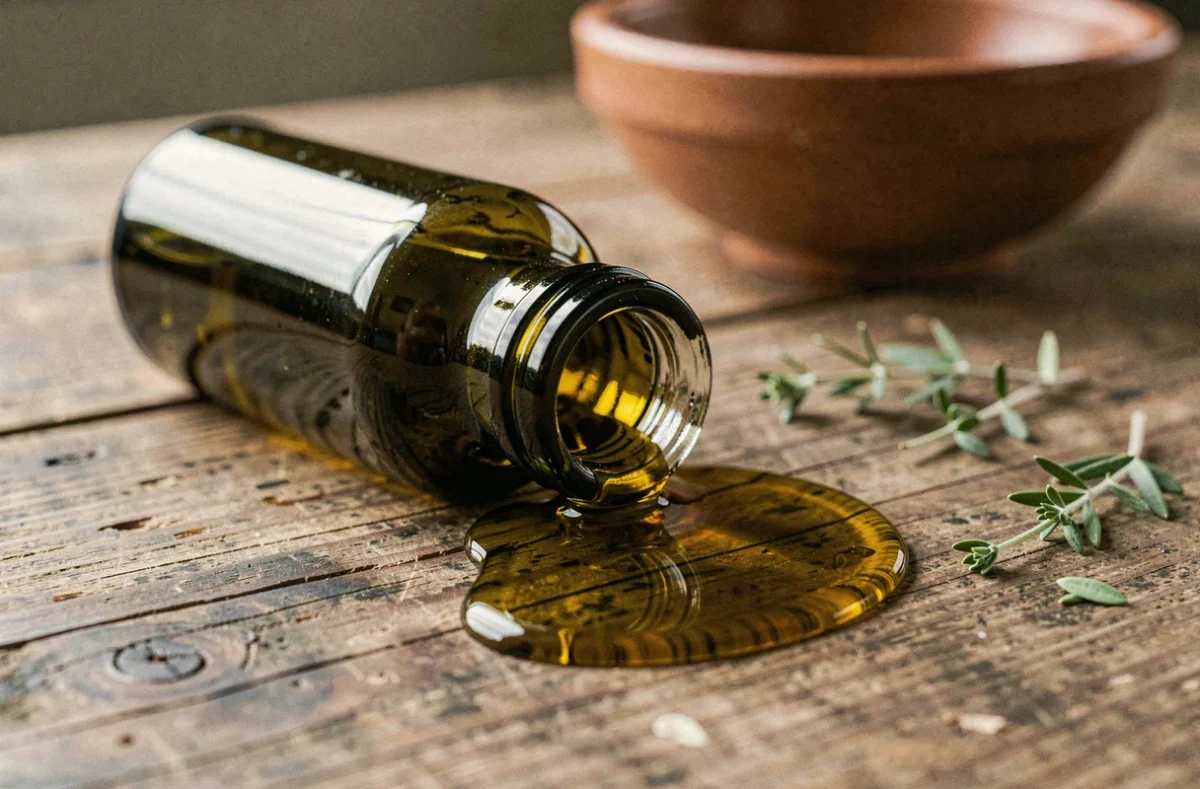
In many cultures, spilling oil is not just a household accident. It triggers a reaction that goes beyond cleaning up: irritation, a vague sense of unease, sometimes a worry that is hard to put into words. This emotional charge stems from the place oil holds in the collective imagination—as a nourishing substance, a sacred material, and a precious resource whose loss always seems to mean something.
Spilled oil and emotional reactions: what a household mishap reveals
Before discussing omens or spirituality, it is worth looking at what actually happens when oil spills across a countertop or floor. The first reaction is almost never neutral.
Some people feel guilty about wasting it, especially when the oil is expensive or was given to them. Others experience a vague sense of anxiety, as if the accident were a sign of something else. This disproportion between the cause (a few centiliters lost) and the emotional effect (a lingering sense of unease) offers valuable insight into our relationship with control and loss.
Exploring the symbolism of spilled oil helps explain why such an ordinary mishap can stir up deep emotions, far beyond simple clumsiness.
Reactions vary depending on personal circumstances. Someone going through financial hardship may experience the spill as an amplified material loss. Someone else, in the midst of a period of self-reflection, may see it as a sign. The same event, radically different interpretations: it is a person’s state of mind at the time that shapes their interpretation, not the oil itself.

The symbolism of oil in religious and cultural traditions
Oil, particularly olive oil, holds a special place in the three major monotheistic religions. It is used to anoint, consecrate, and purify. In these contexts, it is not merely a fatty substance but a vessel for the sacred.
This symbolic significance explains why spilling oil can carry different emotional weight depending on a person’s culture. The distinction between everyday and ritual use radically changes how the accident is interpreted.
- In a culinary setting, spilled oil mainly causes irritation or regret—emotions focused on material loss.
- During a religious rite or prayer, the same act may be seen as disrespectful, a break in communication with the sacred, and may give rise to shame or anxiety.
- In some Mediterranean folk traditions, spilling olive oil is considered a bad omen, while other cultures see it as a sign of future abundance.
This range of interpretations shows that there is no universal meaning to spilled oil. Local beliefs shape the emotions people feel, not the other way around. Presenting a single interpretation as “the” truth would mean mistaking a cultural trait for a universal law.
Spilled oil in dreams: dream interpretation and emotional life
Dreams of oil spilling are a recurring motif in dream analysis. Oil functions as a symbol of fluidity, inner resources, and what allows things to work smoothly.
When oil spills in a dream, the most common interpretation points to a loss of emotional resources or energy. The dreamer may be going through a phase of giving too much without replenishing themselves, or letting abilities they could be using go to waste.
What changes the meaning of the dream
The dream’s context changes how it can be interpreted. Oil overflowing from a full container does not mean the same thing as oil spilled by accident or by someone else. In the first case, the dream may suggest emotional overwhelm. In the second, it points more toward a feeling of losing control.
The emotions felt during the dream matter just as much as the scene itself. Feeling panicked as the oil flows may suggest anxiety about wasting one’s own energy. Watching the scene calmly may indicate a degree of acceptance of what is beyond one’s control.

Fear of waste and the need for control: a psychological perspective
One aspect rarely explored in common interpretations is what our reaction to spilled oil says about our relationship with control. Oil is difficult to recover once it has spread. It stains, seeps outward, and is hard to clean up. This irreversible quality strikes a nerve for people who need to keep their surroundings under control.
Frustration with the irreversible goes far beyond oil. It brings to mind all the situations in which something slips beyond our control with no way to turn back: a word spoken, a decision made, a missed moment. Oil spreading across the floor becomes a tangible metaphor for the everyday things that cannot be undone.
This perspective does not negate the cultural or spiritual dimensions. It complements them by raising a question that is rarely asked: when faced with an accident, what are we really trying to protect? The oil, or the illusion that everything remains under control?
Everyday life and stress: when a small accident reveals an emotional state
During periods of chronic stress, minor incidents can take on disproportionate significance. Spilling oil can become “the last straw”—not because of the oil, but because the emotional system is already overloaded. The accident does not create the stress; it reveals it.
Paying attention to your own reaction to this kind of everyday mishap offers a simple way to gauge your emotional state. Disproportionate anger, unexpected tears, or, conversely, complete indifference are all signals the body sends about the level of tension that has built up.
Whether it happens in real life or in a dream, spilled oil ultimately acts as an emotional revealer rather than an omen. The oil itself carries no message. It is the person who, through their reaction, expresses something they have not yet put into words.