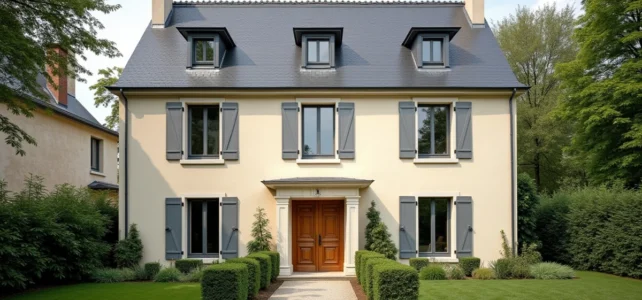
The T5 typology appears in most French real estate listings, but its interpretation often remains vague. Does a T5 refer to a dwelling with five bedrooms, five rooms in total, or something else? The answer lies in a counting convention for main rooms that excludes several spaces from the count. This article measures the discrepancies between what the typology indicates and what the dwelling actually contains, distinguishing between main rooms, service rooms, and layout variations.
Main rooms and service rooms: the counting rule that changes everything
The most common confusion revolves around what the number “5” includes. In French real estate typology, a T5 counts 5 main rooms, meaning rooms used for living or habitation. Service rooms are never included in the count.
This distinction has direct consequences for interpreting a listing. Two properties labeled “T5” can have very different configurations depending on the distribution of bedrooms, living room, and office.
| Type of space | Counted as main room | Examples |
|---|---|---|
| Living room | Yes | Living room, lounge, dining room |
| Bedroom | Yes | Master bedroom, children’s room, office converted into a bedroom |
| Closed kitchen | No | Independent kitchen |
| Open kitchen to living room | No (only the living room counts) | Living space with kitchen area |
| Bathroom, WC | No | Shower room, separate toilet |
| Hallway, landing, pantry | No | Entrance, laundry room |
To find out how many bedrooms in a type 5 house, you need to subtract the living room from the total number of main rooms. The standard configuration thus gives one living room and four bedrooms.
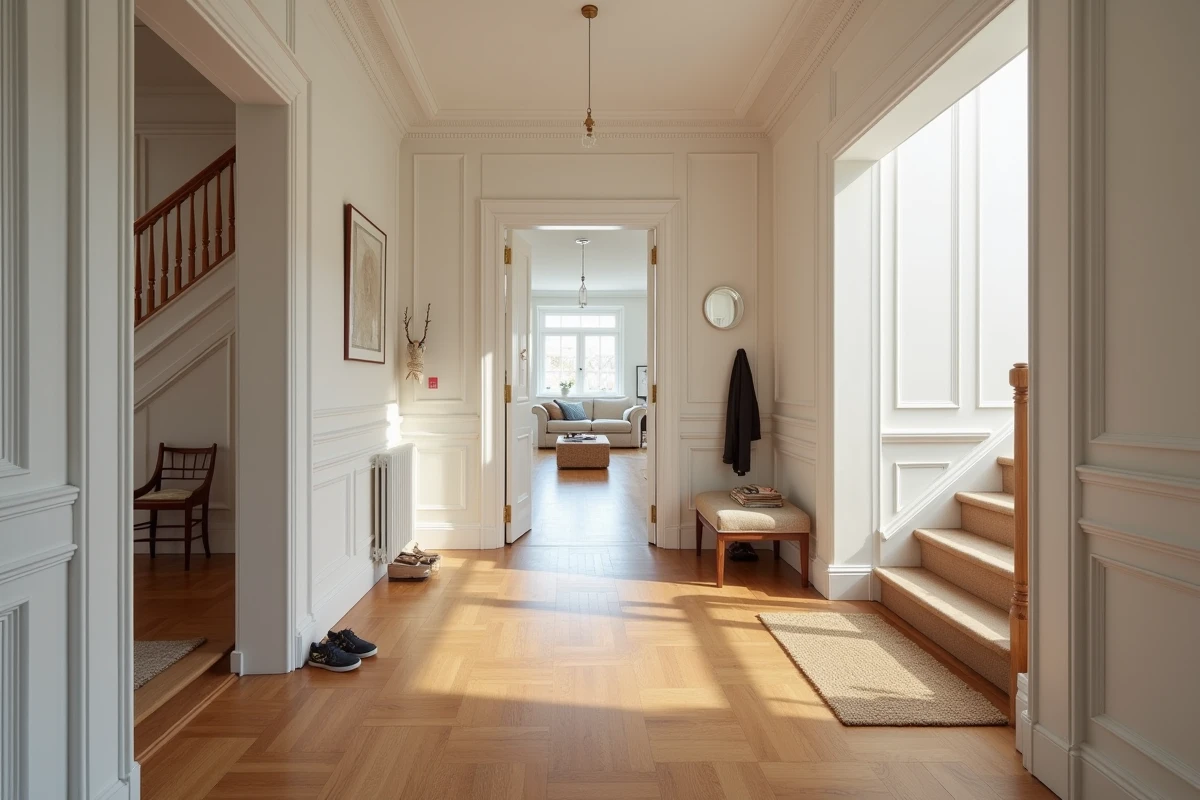
T5 house and T5 apartment: differing areas and layouts
The T5 label applies to both an apartment and a detached house. However, the living area and distribution of spaces vary significantly between these two formats.
In an apartment, a T5 is generally found in older buildings or family residences. The rooms are often arranged in a linear fashion or around a central hallway, and the total area is limited by the building’s constraints.
In a house, the T5 offers a wider layout flexibility. The distribution over two levels is common: living spaces on the ground floor, bedrooms upstairs. Some T5 houses include converted attics as an additional main room, which alters the bedroom/office distribution without changing the typology.
Ceiling height and minimum area per room
For a room to be counted as a main room, it must meet criteria for area and ceiling height. The decency decree of 2002 imposes a minimum height for living spaces. A room that is too low in ceiling height or too narrow cannot be counted, even if it is used as a bedroom on a daily basis.
This point is particularly sensitive in houses with converted attics or mezzanines. A sloped space may serve as a bedroom in practice, but may not be included in the official count of main rooms if the ceiling height falls below the regulatory threshold over a significant portion of the area.
T5, F5, and “5 rooms” in listings: three terms, one reality
Real estate listings use T5, F5, and “5 rooms” interchangeably. These three terms refer to the same thing: five main rooms excluding kitchen and sanitary facilities. The “T” comes from “type,” while the “F” comes from “function.” The difference is purely terminological.
The confusion arises more from the commercial usage of platforms. Some portals display “5 rooms” without specifying whether the open kitchen has been counted or not. Others mention “4 bedrooms” in the title and “T5” in the technical sheet, which is consistent but not always read correctly.
- T5 and F5 refer to the same count: five main rooms, generally one living room and four bedrooms
- An open kitchen to the living room does not create an additional room; only the living room is counted
- Service rooms (bathroom, WC, hallway, pantry) never alter the typology
- A T5 bis indicates the presence of an atypical additional room (nook, mezzanine) that does not fit into the standard classification

Layout variations of a type 5 house: beyond the standard configuration
The distribution “one living room + four bedrooms” is the most common, but not the only possible one. A T5 can also include a double living room (separate lounge and dining room) and three bedrooms. In this case, the number of main rooms remains the same, only their allocation changes.
This flexibility has a direct impact on the use of the dwelling. A family with two children may prefer a T5 with four bedrooms to dedicate one room to an office or a guest room. Conversely, a childless couple may prefer a double living room and fewer bedrooms.
The case of T5 bis
The suffix “bis” indicates an additional room that does not meet all the criteria of a standard main room. It could be a large nook, an open mezzanine, or a convertible corner. A T5 bis thus offers an intermediate space between the T5 and T6, without crossing into the higher category.
This nuance affects the price. A T5 bis often negotiates slightly above a classic T5, as the usable area is larger, even if the additional room cannot be declared as a bedroom in the regulatory sense.
The T5 typology is based on a count that excludes kitchens, sanitary facilities, and hallways. The most common configuration combines a living room with four bedrooms, but variations with a double living room or multifunctional room change the use without altering the classification. Checking the plan and areas room by room remains the only reliable way to confirm what a T5 listing actually contains.