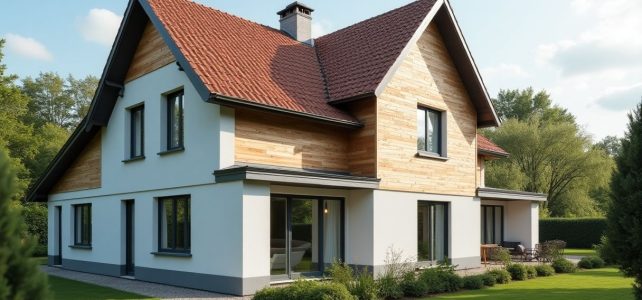
In the face of the climate emergency and the constant rise in energy costs, renovating the thermal envelope of one’s home has become a priority. Thermal insulation is an effective solution that improves indoor comfort while reducing energy consumption. Among the available methods, external insulation stands out for its numerous advantages. It offers a significant improvement in the thermal balance of the building and also helps to enhance the durability of the structures. In addition to ensuring better temperature regulation and limiting thermal bridges, this technique preserves the usable interior space.
The advantages of external insulation
When it comes to improving the energy efficiency of a building, external insulation offers a multitude of benefits.
- Remarkable thermal efficiency: By enveloping the building, it significantly reduces heat loss. The walls act as a thermal barrier, preventing temperature variations from penetrating indoors.
- Preservation of interior space: Unlike interior insulation, it does not reduce the usable space. Residents thus enjoy all the available space without compromising comfort.
- Aesthetic improvement: This method allows for a fresh look to the exterior of a building. The various finishes offer a wide range of styles to enhance façades.
- Durability and protection: It protects the structure against climatic aggressions, thereby prolonging the lifespan of construction materials.
The materials used for external insulation
Choosing this type of insulation involves selecting from various materials, each with its own characteristics.
Expanded polystyrene (EPS) panels are often favored for their lightness and insulating capacity. They offer an excellent quality-price ratio and are easy to handle.
Rock wool boards, on the other hand, are known for their fire resistance and ability to absorb external noise, providing a dual function.
Wood fiber insulators appeal for their ecological and breathable nature. They integrate perfectly into projects where environmental footprint is a priority.
Finally, polyurethane panels, although more expensive, guarantee optimal insulation even in the harshest climates.
Key steps in implementation
For external insulation to be effective, its implementation must follow well-defined steps.
- Preliminary analysis: An assessment of the condition of the exterior walls is essential. This helps determine the necessary preparatory work.
- Installation of the insulation: The insulating panels are fixed to the exterior walls using an appropriate fastening system. Precision is essential to ensure uniformity of the insulation.
- Application of a finishing coat: Once the insulation is in place, a specific coating is applied to protect the insulation and enhance the aesthetic appearance of the building.
- Quality control: A final check ensures that the insulation is homogeneous and that the sealing is guaranteed. This ensures the longevity of the installation.
Financial considerations and available assistance
Investing in external insulation can represent a significant initial cost. However, there are various aids available to lighten this financial burden.
Governments encourage energy renovation work by offering grants and tax credits.
In France, the MaPrimeRénov’ scheme allows for financial assistance proportional to the household’s income. It is also possible to benefit from the zero-interest eco-loan to finance this work.
By consulting certified RGE (Recognized Environmental Guarantee) professionals, homeowners can take advantage of these aids while ensuring the quality of the installation.
Investing in this insulation method is not only an ecological choice but also an economic one in the long term, thanks to the energy savings achieved.