
30%: this is the annual growth of generative artificial intelligence, while less than 10% of companies truly harness its power. Now, automated cybersecurity no longer chases threats: it anticipates them.
Behind this frantic pace, European regulators are reinventing the rules, forcing algorithm transparency. Start-ups are reshuffling the deck on the use of voice interfaces in daily work. Meanwhile, cloud giants maneuver behind the scenes and ally with new players, from healthcare to mobility. Innovation is accelerating, and benchmarks are changing.
What 2024 has in store for us: an overview of major tech trends to watch
For those following technological news, 2024 promises to be action-packed. Generative artificial intelligence is taking a new leap: OpenAI is aligning unprecedented advancements, Nvidia is establishing itself across all sectors, armed with its chips. AI is no longer just imitating; it is propelling every profession. It is being called upon to automate risk assessment, generate custom content, or optimize every step of a business process.
The response to cyberattacks is being organized: tools for proactive cybersecurity are gaining ground. Now, companies no longer just react; they anticipate. Meanwhile, the Internet of Things (IoT) is expanding to everything that captures, counts, or alerts, from factories to cities. However, this proliferation of connected devices raises other issues: data, sovereignty, technical compatibility, new governance models.
In the wake of immersive technologies, augmented reality, virtual reality, or XR are gaining their place: no longer just for experimentation, but for training, healing, entertaining, or selling differently. Europe is making heavy investments in green tech, nuclear fusion, and the transition to a decarbonized digital world. In France, superapps are making their mark: a single app to consolidate messaging, payment, scheduling, and shopping, without switching from one interface to another.
Innovations are piling up: automation, blockchain, Web3, robots leaving factories to join logistics, genetic editing, edge computing, the list grows longer every quarter. The challenge remains to turn these announcements into real value. To understand the impact on strategies and follow the thread of these developments, keep an eye on tech news on InnovoTech.
Artificial intelligence, augmented reality, green tech… Which innovations will truly change our daily lives?
Artificial intelligence has embedded itself almost everywhere. Medical diagnosis, financial risk scoring, preventive cybersecurity: algorithms are stepping in at the front line. In schools, adaptive platforms guide students, while marketing thickens thanks to the on-the-fly generation of texts or images.
On the augmented reality (AR) side, applications are transforming the customer journey. You can wear glasses to try on a pair of shoes without touching them, or visit an exhibition enriched with virtual content. For training, virtual reality (VR) is becoming essential: simulating a medical emergency, repeating an industrial gesture, all fields are opening up to immersive training. These devices are moving beyond the gadget stage.
Green tech is advancing and is no longer just a passing trend. Between green data centers, AI to reduce energy consumption, and the choice of eco-friendly devices, the shift is underway. The challenge? To lighten the carbon footprint without hindering progress.
Automation and then hyper-automation are entering the workflow: robots for handling, warehouse drones, ever more precise 3D printers. As for superapps, they centralize everything: daily management, urban services, banking, and platforms in just a few gestures.
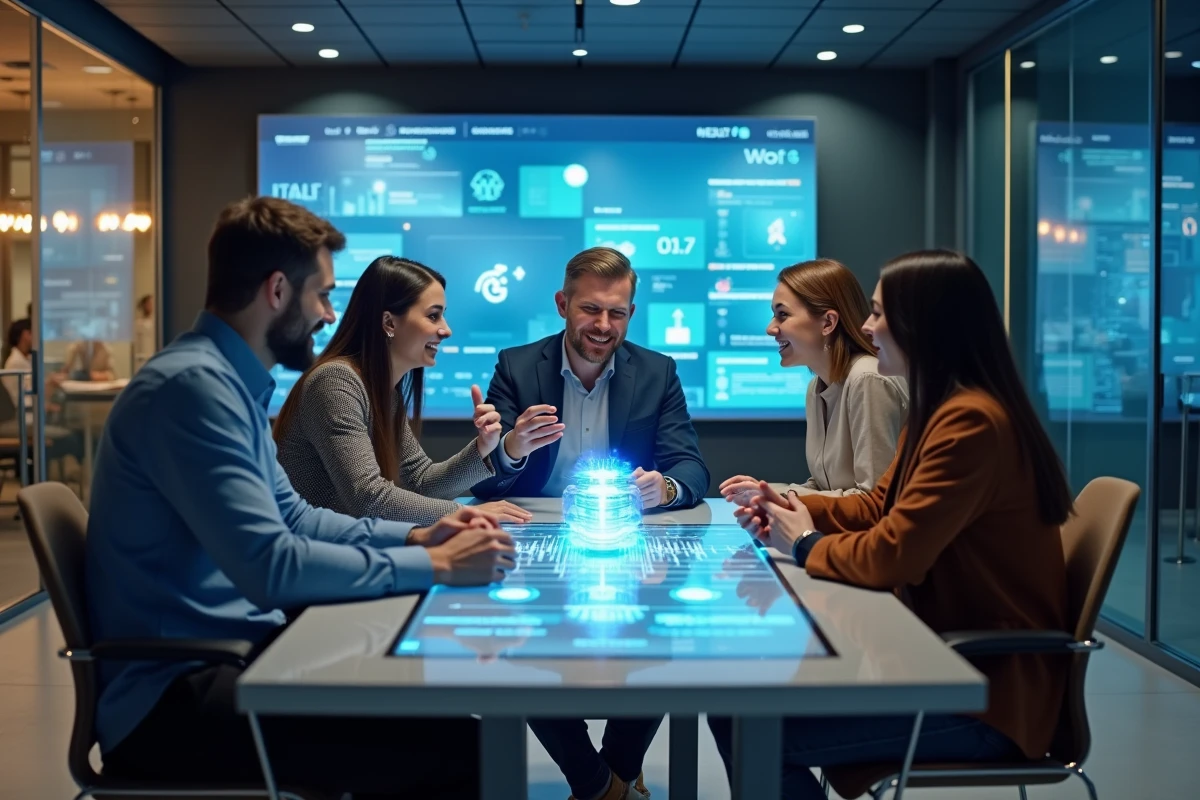
And you, how will you integrate these innovations to stay ahead? Share your ideas and experiences!
Digital transformation is embodied in concrete choices, tested in the field. Flexible organizations are launching automation experiments, placing data governance at the center, and trying out artificial intelligence pilots in small groups. In Paris, training workshops on proactive cybersecurity prepare employees to face ever-new scenarios.
In industry, connected sensors are everywhere, predictive analytics, and optimization of the production chain: the Internet of Things is shaking up old habits. In healthcare, AI is stepping in to triage patient flows, assist medical decisions, and speed up diagnosis. A pioneering hospital in Marseille is now training all its doctors on new software, which does not prevent questions about the right place for technology.
On the training and customer experience side, augmented reality and then virtual reality are changing the game. Those testing extended reality are already seeing benefits: quicker onboarding, improved retention, secure experimentation of critical processes. On the environmental axis, integrating Green IT and reinventing the digital chain are increasingly weighing in strategic decisions.
The last lever, but not the least: creating a climate conducive to experimentation, uniting expertise, and sharing without filters what works or what doesn’t. Each sector is charting its own course, sometimes against the tide. Who will be the next to initiate the unpredictable break that disrupts habits and breaks down sectoral boundaries? The story is never written in advance.